I love to walk, and when I do, I listen to podcasts. By the way, it’s safe for me to listen because I’m walking on my property, up and down the main road to a gate out in the middle of nowhere with no fear of traffic coming or going. I heard Gary Brecka’s podcast, “The Ultimate Human,” recently and he interviewed Dr. Courtney Conley about her new book, co-authored with Dr. Milica McDowell, titled “Walk: Rediscover the Most Natural Way to Boost Your Health and Longevity—One Step at a Time.”
It changed my life.
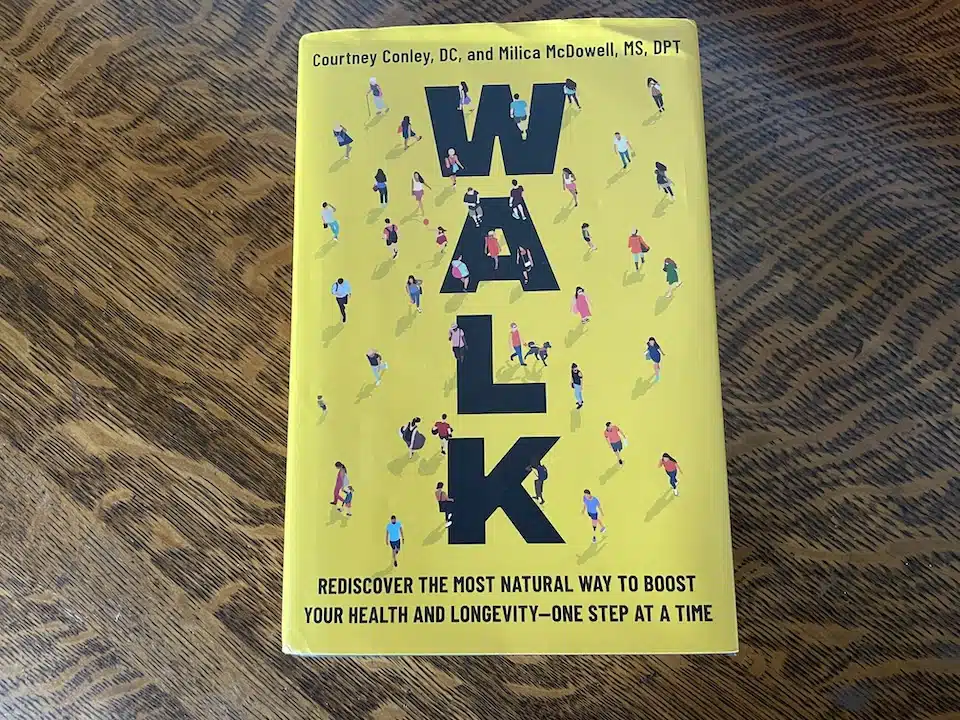
First, here’s the description that drew me to Brecka’s podcast episode with Conley: “I sat down with Dr. Courtney Conley and what she told me stopped me cold … your walking speed can predict dementia up to seven years before the first cognitive symptom appears, which is why scientists are arguing it should be added to blood pressure and temperature as the sixth vital sign. We got into the mechanism behind it: BDNF, hippocampal neurogenesis, and why 4,000 steps a day can cut dementia risk by roughly 50% and I walked away convinced this is the most under-prescribed medicine of the 21st century.”
I began listening because of the relationship between walking speed and dementia, and wound up buying and reading the book cover-to-cover and changing my lifestyle and footwear accordingly.
The book urges readers to “discover the twenty-first century’s most under-prescribed medicine and the key to health and longevity.” Now that I have entered the “golden years,” (Hello, Medicare!), I realize how fast our time goes and how little I have left. I desire to spend whatever time God gives me in the best possible health and shape. This book will and has helped.
Besides, people will not generally walk if their feet hurt. If their feet hurt, according to the authors, the pain can radiate up the body and affect other joints along the way.
Conley is well qualified to write a book like this, since she earned a doctorate in chiropractic medicine and two bachelor’s degrees in kinesiology and human biology. She has worked with professional sports teams, and presently works at Total Health Solutions and Total Health Performance in Colorado. Meanwhile, the co-author, McDowell, also is eminently qualified and holds two bachelor of science degrees (in exercise physiology and health promotion) and a master’s and doctorate degree in physical therapy. Her CV includes teaching at a university and presenting more than 300 educational lectures across the nation.
In the first chapter, the book states that walking is one of three physiological functions we need in order to survive well, along with breathing and sleeping. They are interconnected and what make us human. In fact, the authors call walking “vitamin W,” as essential as vitamins D, A, C, B-12 and others. They believe you should include walking daily. And here’s where they first debunk the myth of 10,000 steps per day. (Note to self: How many years have I strived to achieve this goal? And why?)
The book states, “It’s not 10,0000 steps. That benchmark actually originated form a 1060s-era Japanese pedometer company’s marketing campaign,” and not from scientific research. The authors think this number discourages people from walking, because they can’t achieve this goal daily. The authors believe that somewhere between 2,500 and 8,500 steps a day will positively impact your health. And then, they designed, in chapter 11, three walking programs to fit your lifestyle: Base, Build and Boost. You can transition from one to the other. Right now, I fit into the Boost category, because I am walking (on average) 8,000 steps per day (along with rowing and weight lifting three times a week). You also have to measure your gait, and determine whether you’re walking fast enough. Walking faster than you think you can takes some of the stress off your feet, too.
According to the authors, at a certain point after 9,000 steps, you might be seeing diminishing returns when walking, and you might better spend your time weight training and … foot training.
And to that end, they included and designed evaluations of your feet for strength and agility, and several easy-to-follow and well-illustrated exercises.
In the chapter titled “What Shoes Should You Wear?” the authors state immediately that there is no easy and quick solution and that finding shoes that fit properly can take time. Most traditional walking shoes have a heel drop of about 8-to-12 millimeters (almost ½ inch), which is unnatural when comparing it to our natural anatomy.

The authors much prefer their clients to seek functional or minimal shoes, and goes on to explain the difference between a functional shoe and a minimal shoe. I included the two shoes I’ve been wearing with success above. I wear the Vivobarefoot shoe when running errands, and the Merrell Women’s Trail Glove 7 on the roads.
Functional shoe criteria includes the following specifications:
Minimal Shoe Criteria has these specifications:
Me being me, I went for the minimal shoe right away and didn’t even transition, and within a few days, my feet stopped hurting. Had I experienced pain, I would have found a functional shoe as a transition. Although, to be honest, I sent back a pair that didn’t work (Thank you, Amazon!).
In the chapter titled “The Transition Mission,” they not only convinced me to ditch my Hokas and try walking in a barefoot shoe for the first time in my life, but also, I now walk barefoot – skin on the floor – as much as possible in my home. It’s working. Not only do my feet hurt less, but I believe they are getting stronger and my hips don’t ache.

According to the authors, the “Journal of the American Medical Association” published data in 2022 that stated that people who walked about 5 miles a day were 51 percent less likely to develop dementia, and those who walked 2 miles a day were 2.5 percent less likely. The pace matters, as well. We’re not talking about a stroll in the park here. It needs to be a brisk walk and you can time your gait to see if your stride is “brisk enough.” In fact, the authors surmise that a slower gait might signal an onset of dementia years before it happens. This information has caused me to clip about 2 minutes off my pace per mile so far. (An average “brisk” gait speed equals about 130 steps per minute.)
If you’re interested in finding out more about the authors’ mission – to strengthen people’s feet – check out Conley’s website, “Gait Happens.” She offers foot fitness programs and individual consultations. I’m seriously considering signing up for “The Feet Fit Program.”

You may also find McDowell at her website, where she books appointments.
You may purchase Walk:Rediscover the Most Natural Way to Boost Your Health and Longevity—One Step at a Time” at Amazon for $23.95 (hardcover). Or, maybe you should buy the audio book and listen to it while you’re … walking.

Publisher/Editor Barbara Baird is a freelance writer in hunting, shooting and outdoor markets. Her bylines are found at several top hunting and shooting publications. She also is a travel writer, and you can follow her at https://www.ozarkian.com. View all posts by Barbara Baird